
I was wrong about Jump
but maybe not for long?

I need to set the record straight.
Jump is not, in fact, building a CRM.
And this is disappointing for a couple reasons… one, because I was pretty sure they were, and two, well because it would be really cool if they did (Slant and Wealthbox could use some friendly competition)!
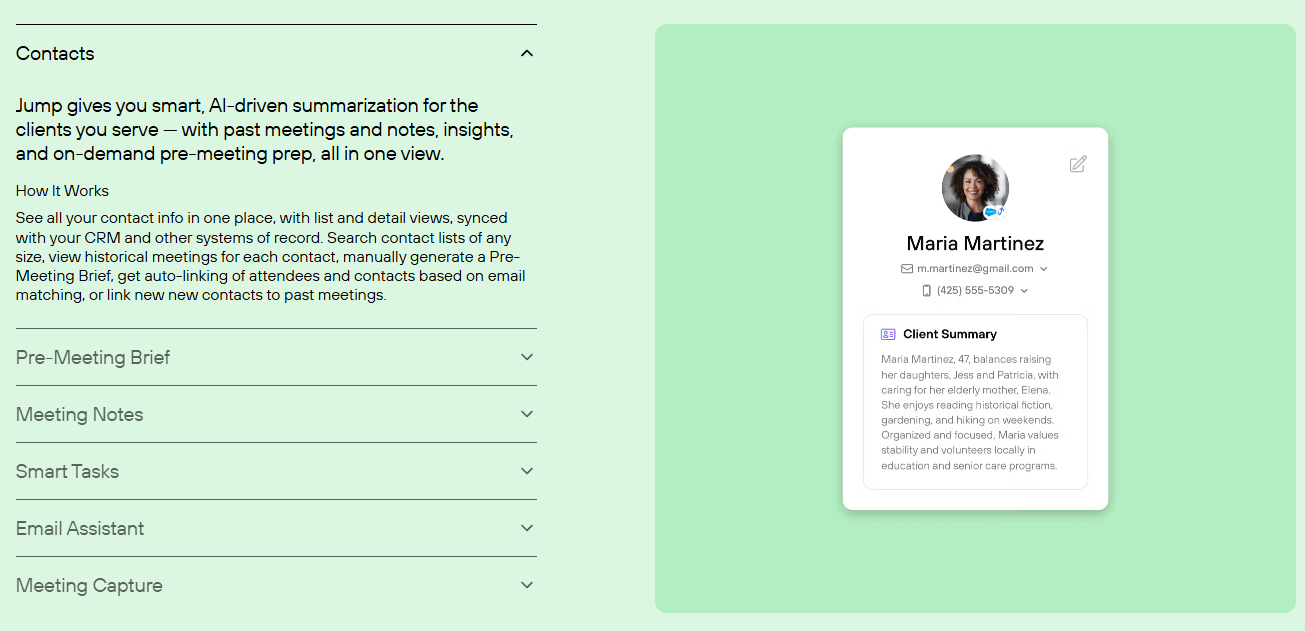
I took some creative liberty based on the website/brand refresh both of which turned out to be farce:
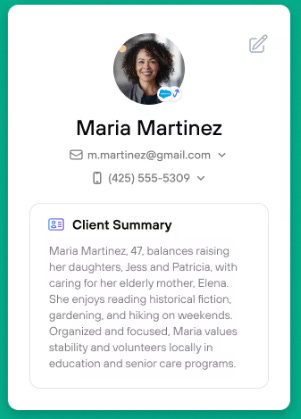
⬆️ I can’t find this UI anywhere in the Jump app.
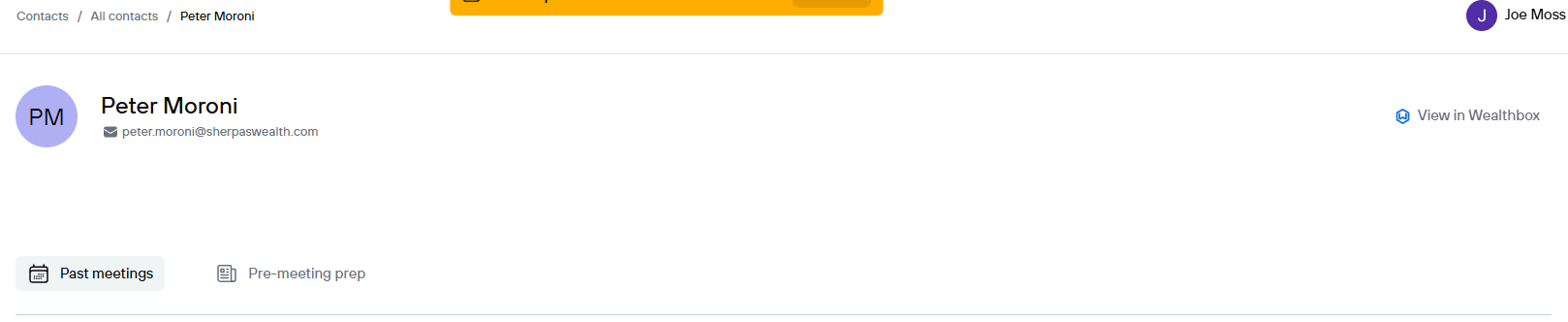
⬇️ This is what a contact record looks like and there’s no place to edit it or create contacts from what I can see:
And there’s this in the welcome email:
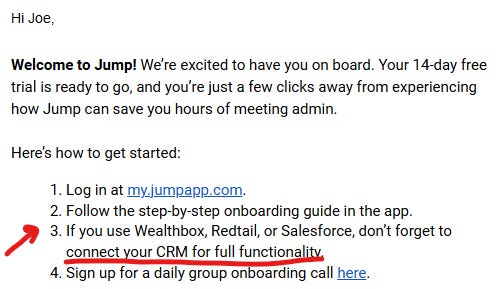
You only get partial functionality until you connect a CRM.
You see, I tried a couple CRM integrations, starting with the free version of Hubspot, and the “All Contacts” section in Jump disappeared (I think you have to have a paid subscription to Hubspot to enable the contact sync).
After connecting Wealthbox, the contacts flowed in, but without much detail and any edits seem to be directed back to the contact record in Wealthbox.
So this “central source of truth” thing wasn’t quite true either.
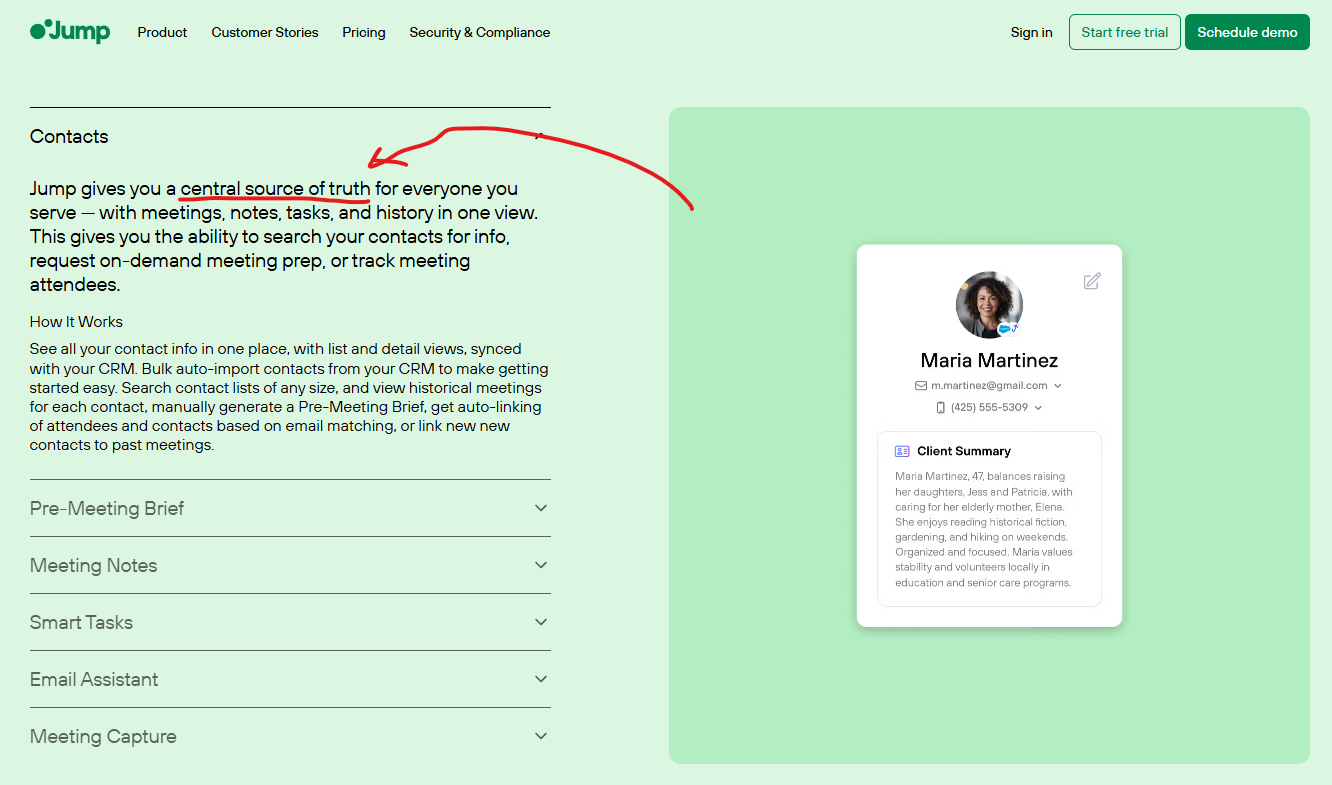
They have since changed it:
So why does this matter?
Sam Corcos (he has an epic podcast with Tim Ferriss too) is the new CIO for the U.S. Treasury (6 months in the position as of this podcast:)
The podcast is an excellent look into just how badly the government runs and is honestly kinda frustrating to listen to. :)
But here’s where it relates:
1:40:02 “As of last count… the IRS has about 108 competing sources of truth… so this is our number one priority is data quality… we need to get to the point where all of our systems are using the same information under the hood”
If the customer service team wants to check someone’s address, they have to check a bunch of different systems in order to then use some judgement on which they think is accurate…
Sound familiar?? The IRS has an integration problem too!
The CRM is where you keep track of information like this… could it be the custodian, or the financial planning tool, or the AI notetaker? Yeah, sure, but that is the CRM’s job generally, is to be the most accurate representation of a contact’s information.
But is it though?
Not at all… from my time working in CRM consulting and doing assessments, CRMs can be a real mess. And I hear that AI works better when data is clean, accurate, organized… sooo
Combining AI internally within the CRM… ok, ok, I’ve waxed eloquent on that before.
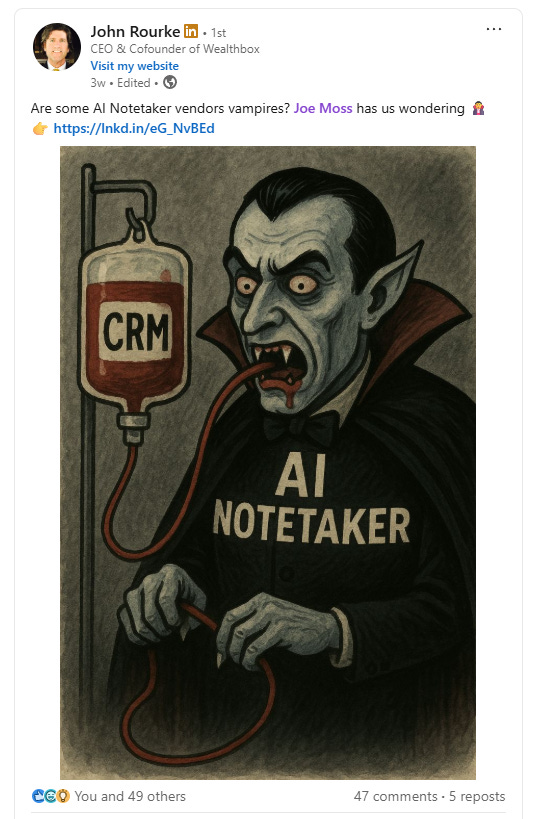
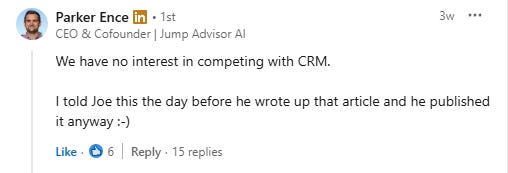
So to sum it all up, Jump is not building a CRM, they’ve denied it on podcasts, on LinkedIn, changed their website to be less “CRM-y”…
and even denied being a CRM vampire:
Which means there will be two pretty distinct categories as AI Notetakers grow up.
The Vampires
The uhhh…
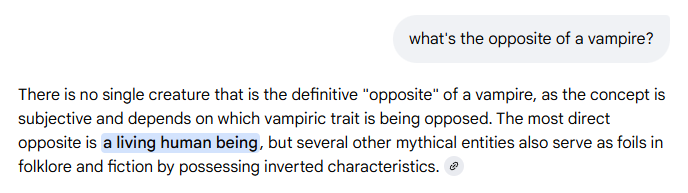
Ha, good one.
The AI+CRM in one’s.
Looks something like this (WAIT, is that prospecting??)

Oh, but there’s so much more to talk about!
In Episode 7 of the “AI for Advisors” podcast, Sindhu Joseph of CogniCor says:
Many advisors who see our demo ask the first question: “So, do you mean to say that I can unsubscribe from my Redtail subscription? With CogniCor, can I do all of these things?” The short answer is yes. I’m saying that AI tools will predominantly take over. I’m not saying that CRM will immediately go away. The premise of this argument is that CRMs are built around accounts and households and the data around that; it’s kind of a glorified database. Whereas AI tools are built around household interactions and things like that. So, a new model is emerging around these interactions around the household, and CRMs can either adapt to that or become irrelevant.
I don’t think any CRM is taking this sitting down. Wealthbox, for example, has its own note-takers, and they are becoming more and more AI-centric in their approach. So, it really depends on who is going to evolve faster and claim that space. The advisor, at the end of the day, wins because previously, they had to adapt to the CRM. Now, the CRM has to adapt to the advisor’s workflow because it is workflow-centered. All the tools are going to come together, and as I said, the interaction is going to be predominantly with an AI experience.
Kind of like Covid-19 was a catalyst for Zoom, remote work, etc… AI is a catalyst for CRMs to grow up and do the things it feels like they should have done a long time ago
Data gathering
Scheduling
Proactive insights
Prospecting and data enrichment
But does this mean they need a new name, or new category?
A couple other can’t-miss conversations:
James Cantwell’s LinkedIn article:

and Zero Basis Points’ podcast rebuttal:

Whatever you choose to call the thing… it stands to reason:
ya need a contact source of truth
it’d be nice if the data and the AI were in one system
it’d be nice if CRMs did more so that you didn’t have to connect 10 other tools
To quote Sindhu again:
So, it really depends on who is going to evolve faster and claim that space. The advisor, at the end of the day, wins because previously, they had to adapt to the CRM. Now, the CRM has to adapt to the advisor.
Cheers,
Joe
P.S. This probably doesn’t require it’s own post, but it is an excellent summary of AI and creativity: